





Oh and here is a capture of the included Fuzz into amp profile. Sounds like a Tone Bender to me, HUGE. https://youtu.be/6iRYb5bOsAk
Watch capture demos and our intro to the captures of our 1968 Marshall JMP-100 Super Lead 12 000 series amplifier here:
Get a free capture of this amp for ToneX on ToneNET:
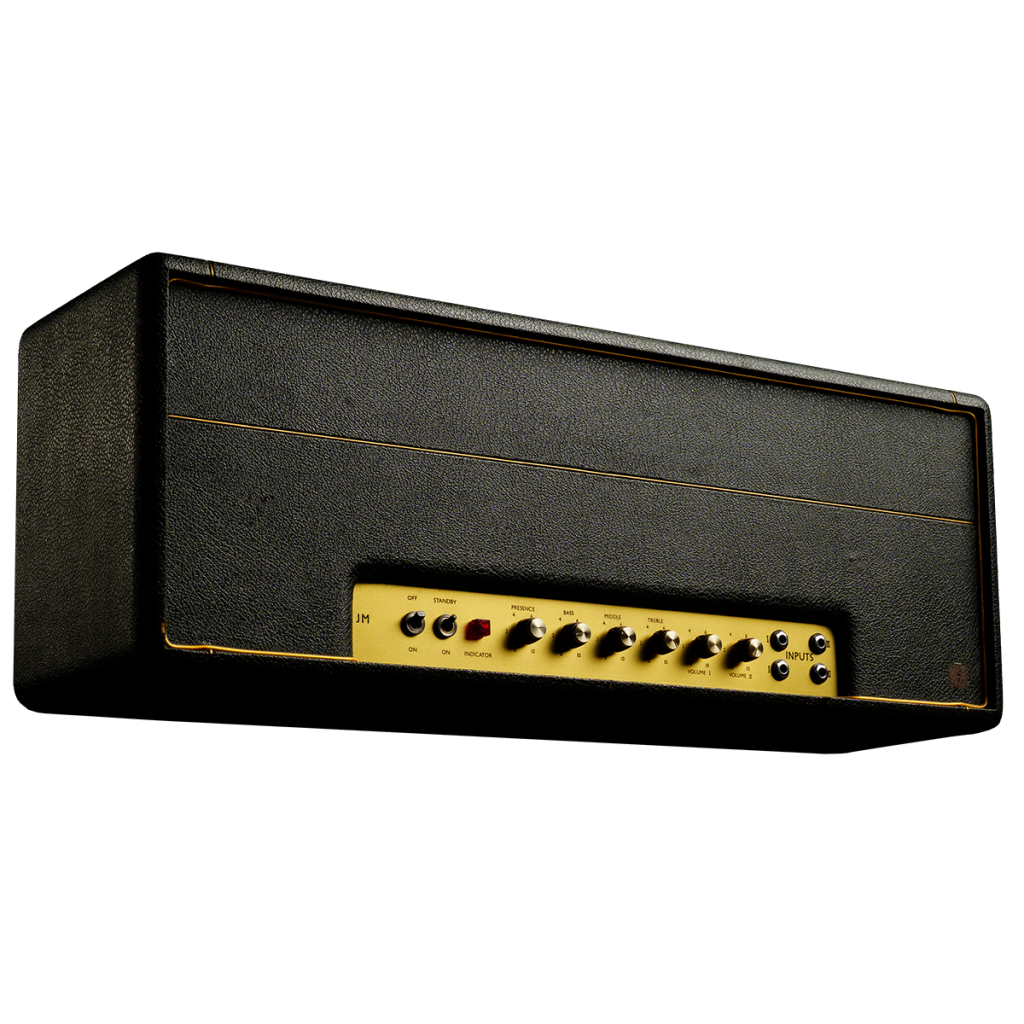
Specifically the 12 000 series 1968 Marshall Super Lead is considered by many to be the epitome of the Marshall Super Lead variants. And besides that it is an amp that is surprisngly hard to get a hold of, as they are in rather small numbers and extremely desirable due to the Eddie Van Halen connection.
At this stage the preamp had received the full lead spec treatment with a large 5000pF bright cap, split cathode setup, both .68uF cathode bypass caps for V1b and V2a. Meanwhile the filtering is lower than on the later style 69 Super Leads and metal panel amps.
This results in a very unique spec in the Marshall history that only these amps had. It has a more fluid or spongy feel than the later Super Lead amps while it has more gain than it’s predecessors and an agression that none of the earlier amps had. The lower filtering makes that agression feel different than on later amps – it is smoother and more compressed, with a more fluid feel.
Obviously the one big name that is closely connected to this amp is Eddie Van Halen. Many other big acts played 68 Super Leads (Jimmy Page, Jimi Hendrix, Paul Kossoff), but it is not well documented, who might have had a 12 000 series specifically.
Our specific unit that we made captures of for this release is about 30 units away from Eddie Van Halen’s 12301. It is a specimen that was made for the swedish market, which is where we picked it up. Plugging it in made it instantly clear that this amp is a ruler and hence it got the name Ragnar – the infamous viking king.
It easily delivers those fluid, gainy tones with the abundance of mids and bite that is hard to match. Using the second channel it is also capable of delivering tones reminescent of ZZ Top’s first album, which seems to have been recorded with a similar spec’d amp, if not a 12 000, which has not been documented.
The second channel in combination with the right settings also delivers beautiful, warm cleans and edge of breakup tones that are not attainable on the channel the most users go for. As opposed to channel jumping it does not result in a mix of a tone that is too bright and a tone that is too dull, but in a very organic tone that is totally underutilised in these amps.
A truly iconic amp tone from the heyday of classic rock that is way more versatile than people give it credit for. Beautiful Marshall cleans up to singing leads – it’s all here.
The set features 25 full captures of the amp (cab baked into the capture). The amp was recorded through a 1968 Marshall 1982B 4X12 with Celestion G12H30 55Hz Pulsonic coned speakers, which are the most iconic 60’s Marshall speaker Used by Hendrix, Pag and countless others. The mics used were 2x Royer R121, a Beyerdynamic M160 and a Neumann U87. Please refer to the full list of included captures in the product photo section.
Our products are digital downloads delivered instantly. By completing your purchase you agree that delivery begins immediately and that you waive your 14-day right of withdrawal, so all sales are final and no refunds are given. This does not affect your statutory rights if a file is faulty or not as described — just contact us at info@amalgamcaptures.com and we’ll put it right. Read our full Refund Policy.
Oh and here is a capture of the included Fuzz into amp profile. Sounds like a Tone Bender to me, HUGE. https://youtu.be/6iRYb5bOsAk
Listen to how dynamic the crunch capture is: https://youtu.be/-oX9bulka0Q?si=kMYKsQUOYtQwdMfh I've been playing guitar since I was 12, and I'm 38 now, so that's a lot of years. And I've been using modeling and capture tech for a long while, since the days of Guitar Rig 5 and even earlier. I've gone through Kemper, Quad Cortex, ToneX, Neural DSP, all of it. Everything sounds pretty good, and it's convenient to go digital, particularly in the studio, where you can have multiple sounds. That's quite cool. But I've never heard anything like the Amalgam captures. I've never been that unaware that I wasn't playing a loud tube amp. I bought the '68 Super Lead, the '67 Super Bass, and the JTM45 Block Logo. The '68 is the one that grabbed me the most immediately. One thing worth mentioning: these profiles are NAM A2, calibrated on the input and the output, which seems to make a big difference in touch sensitivity, in how it feels, and in how the amp reacts to your playing. Clean. The clean side is absolutely amazing, on single coils and on humbuckers, my favorite being single coils. It gives you this thin, in the most beautiful way, sound. Crispy and chimey, with controlled low end, and it almost has the texture of breaking up without really breaking up. It's very clean, it's easy to play, and the notes bloom and sustain. I have a Strat with Lollar '64 pickups and it's chime heaven. Super expressive, really beautiful, clear. I can imagine you'd play Jimi Hendrix or John Frusciante stuff amazingly well on the clean setting. Crunch. The first thing I'll say is that it cleans up with the guitar volume so beautifully. It goes from a proper crunch to beautiful cleans just by using your volume pot, the way a loud non-master amp would. The crunch setting offers plenty of sustain and overdriven texture. It's not distorted, it's overdriven, and very sweet sounding. Incredibly expressive, incredibly touch sensitive. The bright cabinet isn't too bright for single coils, and it's amazing for humbuckers. With single coils it's a bit honky, with lots of presence. With humbuckers it's mellow and mid-high forward, offers plenty of sustain even with PAFs, and gives great note definition. Super creamy, with a beautiful quick attack. The fuzz capture. The included capture with what I assume is a Tone Bender MkIII is just super mega distorted, amazing. Sustain for days. It's like thunder, kind of out of control, and a little stiff. It sustains forever. All in all, it's a rock and roll amp when it's cranked and pushed, but it's a beautiful chimey clean amp too. It's authoritative, but it doesn't overwhelm with any one frequency, particularly not too much rumble. It's just right. It's just what you'd expect from a great Plexi.
choose your platform to find out
Get started in minutes — choose your platform and have access to studio grade tones